The Wreck on Hemlock Bluff
Young Captain Jack · The Son of a SoldierThe Wreck on Hemlock Bluff is the stranded vessel on the Hemlock Bluff rocks where Jack Ruthven’s unknown past begins and where the material proof of his identity is eventually recovered. It is first a site of death and abandonment, then a dangerous place of investigation, and finally an accidental archive: the wreck’s destruction conceals the documents that transform Jack’s story from an unsolved mystery into a confirmed family history.
Setting and Original Disaster
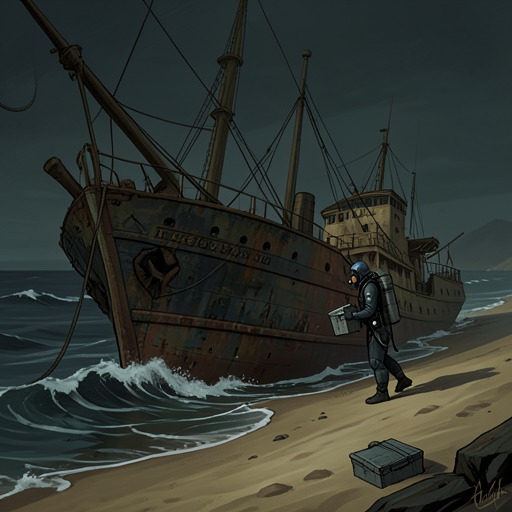
The wreck lies on the rocks of Hemlock Bluff, with its bow raised high on the rocks and its stern projecting over the sea. From the shore it is a persistent landmark, visible from Old Ben’s Boathouse and immediately recognizable to Jack and Marion Ruthven. Its position makes it both accessible and perilous: reaching the deck requires difficult climbing, and the decayed boards demand constant caution.
The ship came ashore between ten and eleven years before Jack and Marion discuss it. On the night of the disaster, the vessel sent up the signal of a ship in distress, then appeared rocking violently while waves swept across its deck. The captain and crew were lost in the ocean, and no passenger remained aboard when the wreck reached the bluff. Old Ben, who was then enslaved on the Ruthven plantation, watched from the bluff and heard a cry after the vessel had been destroyed.
That cry led Old Ben to Jack’s mother on the beach. She had been struck and injured by wreckage, and she was still holding the young Jack when Old Ben reached her. The child could identify himself only by the name his mother had called him. His father and mother had boarded at the last moment, their names were absent from the shipping-office list, and none of the ship’s books survived. The wreck therefore erased the ordinary records by which a passenger’s identity might have been established.
A Site of Memory and Uncertainty
For Jack Ruthven, the wreck is the visible form of a question that has governed his life. After St. John Ruthven tells him that he is a nobody who does not truly belong to the Ruthven family, Marion explains that the Ruthven couple adopted him when he was three or four years old. She points toward the wreck while recounting the night that made him an orphan and a mystery. The location thus connects two competing accounts of Jack: he is legally the Ruthvens’ son and brother, yet biologically he comes from the unnamed passengers of the lost vessel.
The wreck also preserves the limits of testimony. Alice Ruthven and her husband tried to discover who Jack’s parents were, but the missing passenger records and unrecovered ship’s books defeated their efforts. The only recovered bodies were sailors. Clothing from Jack’s family carried no marks, and his mother had nothing in her pocket except an unmarked lace handkerchief. A ring remained among the possessions kept by the Ruthvens, but its worn inscription could not be read, even after two jewelers examined it. These surviving objects offer the promise of recognition without initially delivering it.
The wreck’s presence keeps that failed investigation open. Jack immediately imagines that the missing documents may still lie aboard and asks to row over and search. Marion answers that the wreck has already been searched from end to end and that everything valuable was removed, but Jack’s uncertainty turns the supposedly exhausted site into a new field of inquiry. His wish to inspect it is not simple curiosity: he is attempting to convert an inherited story into evidence.
Exploration and the Hidden Tin Box
When Jack and Marion reach the wreck, Jack climbs aboard despite the difficulty of the approach and helps Marion onto the deck. The vessel is badly decayed, and their movement across it must be careful. The exploration gives the wreck a second narrative life. What had seemed to be only a memorial to the disaster becomes a concealed structure containing spaces that earlier searches failed to disclose.
Later, a surgeon secretly returns to the vessel. The wreck now presents an even more desolate spectacle because everything has been charred by fire. Using a candle, he enters the main cabin and searches for a stateroom, believing that a particular room may contain what he wants. He locates a small closet whose door has no knob, forces it open with a bent nail, and digs through a solid cake of dirt formed where water and dirt entered through a crack.
Beneath that accumulation he finds a heavy black tin box. The box is secured by a small padlock, but the surgeon carries a bunch of keys and eventually finds one that opens it. Inside are a marriage certificate, letters from the husband’s father concerning property, and letters from the wife’s family. The documents are precisely the records missing from the public and shipboard accounts of Jack’s family. The surgeon hides the box beneath his coat and leaves the wreck, treating the discovery not as a recovery for the rightful family but as the basis for his own claim to the fortune.
Evidence, Theft, and Recovery
The black tin box turns the wreck into a contested repository of property and truth. Its contents connect the lost passengers to a marriage and an inheritance, while the surgeon’s removal of the box converts historical evidence into a stolen instrument of power. The wreck’s obscurity makes the theft possible: its burned condition, decayed deck, flooded dirt, and concealed closet allow valuable papers to remain invisible even after earlier searches.
The documents eventually return to the larger conflict through the guerrillas who hold Jack prisoner. After a battle in the mountains kills several outlaws, including the men who had imprisoned Jack, the camp is searched. Among the stolen goods are articles taken from a trader and the tin box removed from the wreck. The box and its contents are turned over to Colonel Stanton.
When Colonel Stanton examines the papers, he recognizes their decisive importance and tells Jack that nothing now stands between them and their fortune. The recovery supplies what the earlier clues could not: the marriage certificate and family letters provide documentary confirmation, not merely resemblance, recollection, or an unreadable inscription. The wreck’s hidden archive therefore resolves both the material inheritance and the personal mystery attached to Jack.
Narrative Significance
The Wreck on Hemlock Bluff functions as a threshold between visible life and buried history. It is where Jack’s mother is found, where his childhood name survives after every formal record disappears, and where the documents capable of restoring his family connection remain hidden for years. Its movement through the narrative is from catastrophe, to silence, to investigation, to revelation.
The location also gathers the novel’s central contrasts. The wreck is a place of death, yet it preserves the means of recognition; it appears exhausted by fire and decay, yet it contains the papers that determine the future; it is searched by people seeking truth, yet a later intruder uses its evidence for greed. Through this repeated return, the vessel becomes more than scenery. It is the material counterpart to Jack Ruthven’s uncertain parentage: damaged, obscured, and apparently stripped of its value, but still carrying the history that makes a recovered identity possible.